
Continuous Deployment
Quick Navigation:
- Continuous Deployment Definition
- Continuous Deployment Explained Easy
- Continuous Deployment Origin
- Continuous Deployment Etymology
- Continuous Deployment Usage Trends
- Continuous Deployment Usage
- Continuous Deployment Examples in Context
- Continuous Deployment FAQ
- Continuous Deployment Related Words
Continuous Deployment Definition
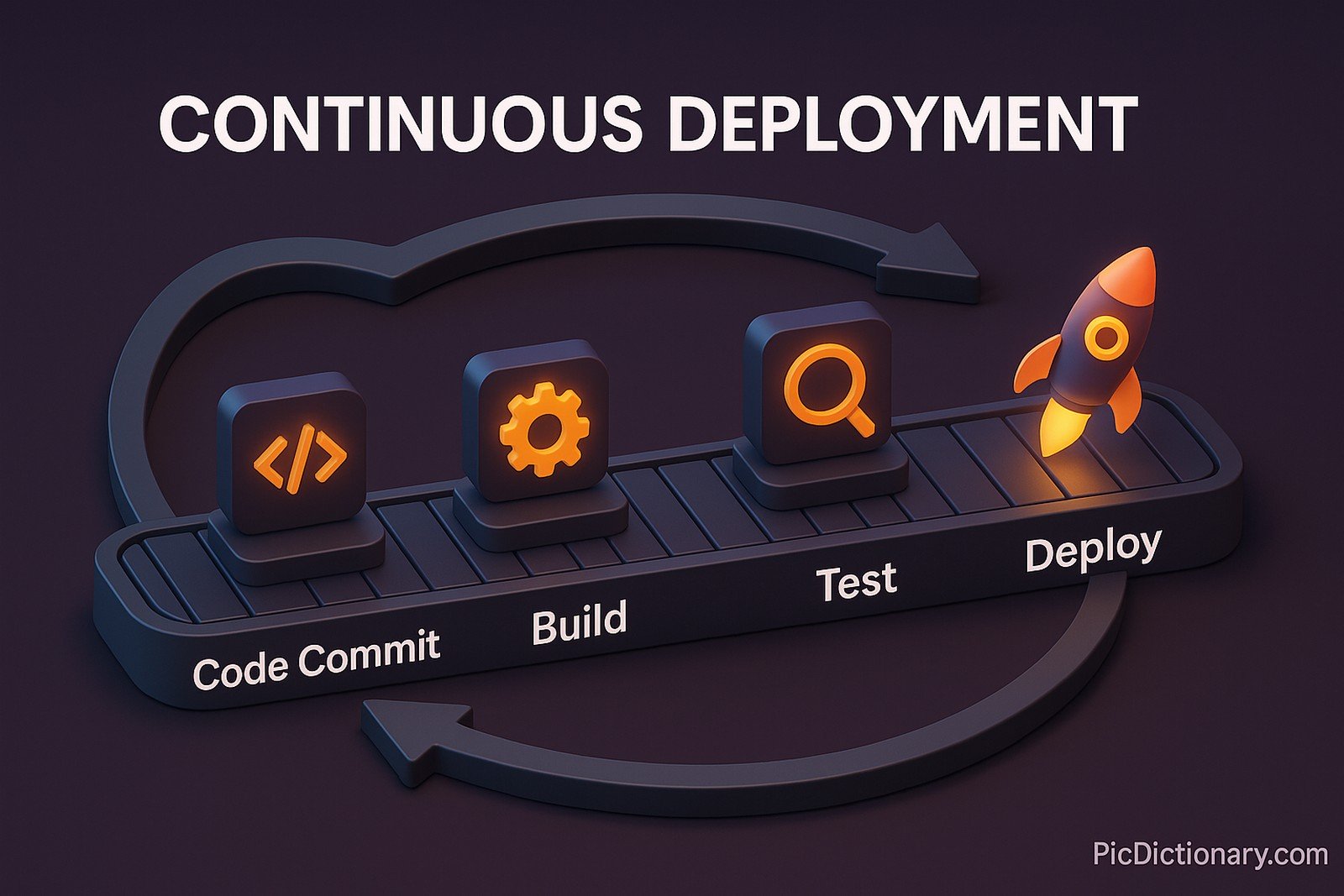
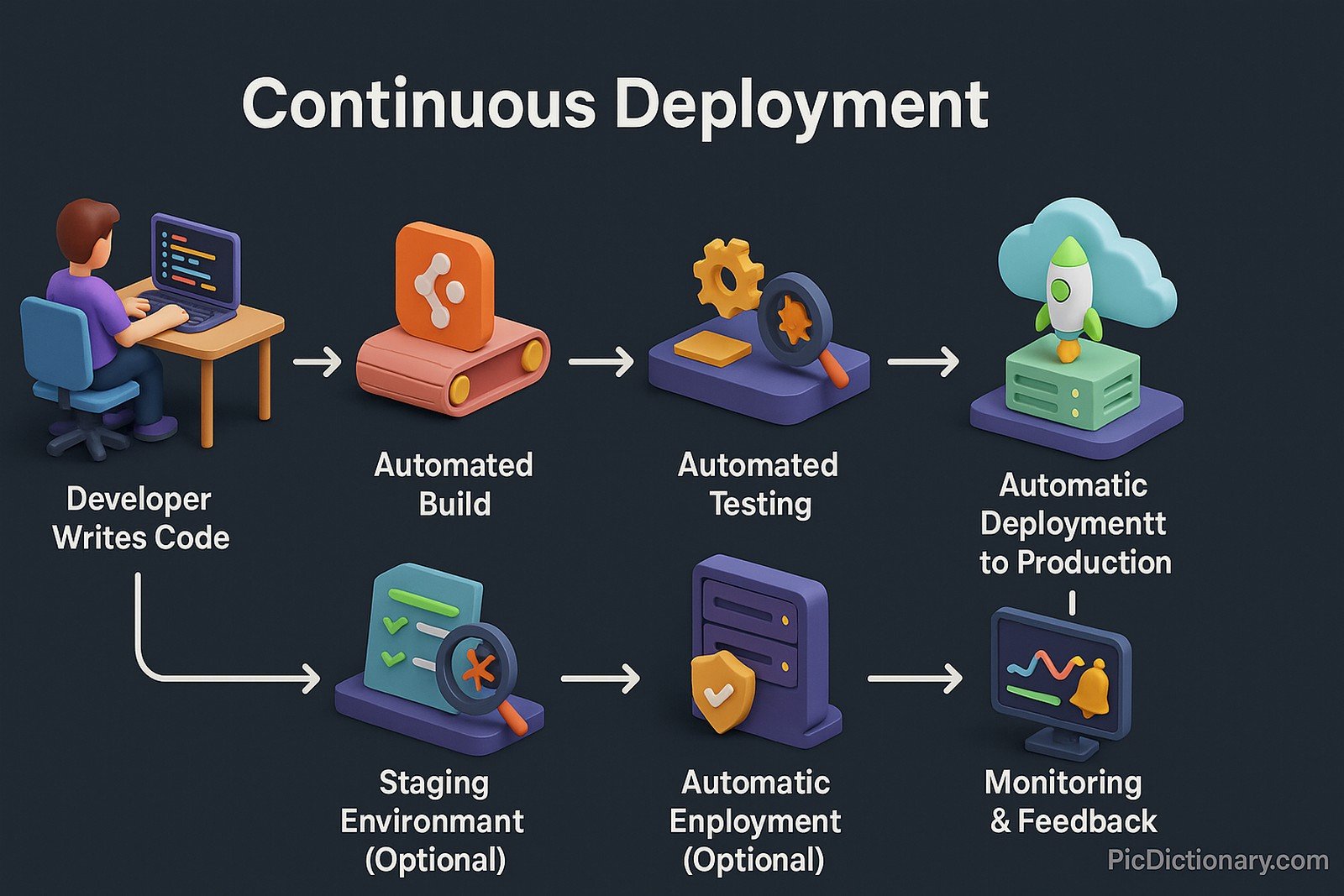
Continuous Deployment (CD) is a software development practice where code changes are automatically deployed to production without manual intervention. This process ensures rapid updates, increased reliability, and minimal downtime. CD relies on automated testing and monitoring to ensure that only validated changes are released. It is a crucial part of DevOps workflows, allowing organizations to push new features and bug fixes to users quickly and efficiently.
Continuous Deployment Explained Easy
Imagine you have a toy robot that gets smarter every day. Every time you teach it something new, it instantly updates itself without you having to press a button. That’s what Continuous Deployment does for software—it automatically applies new updates without waiting for someone to manually approve them.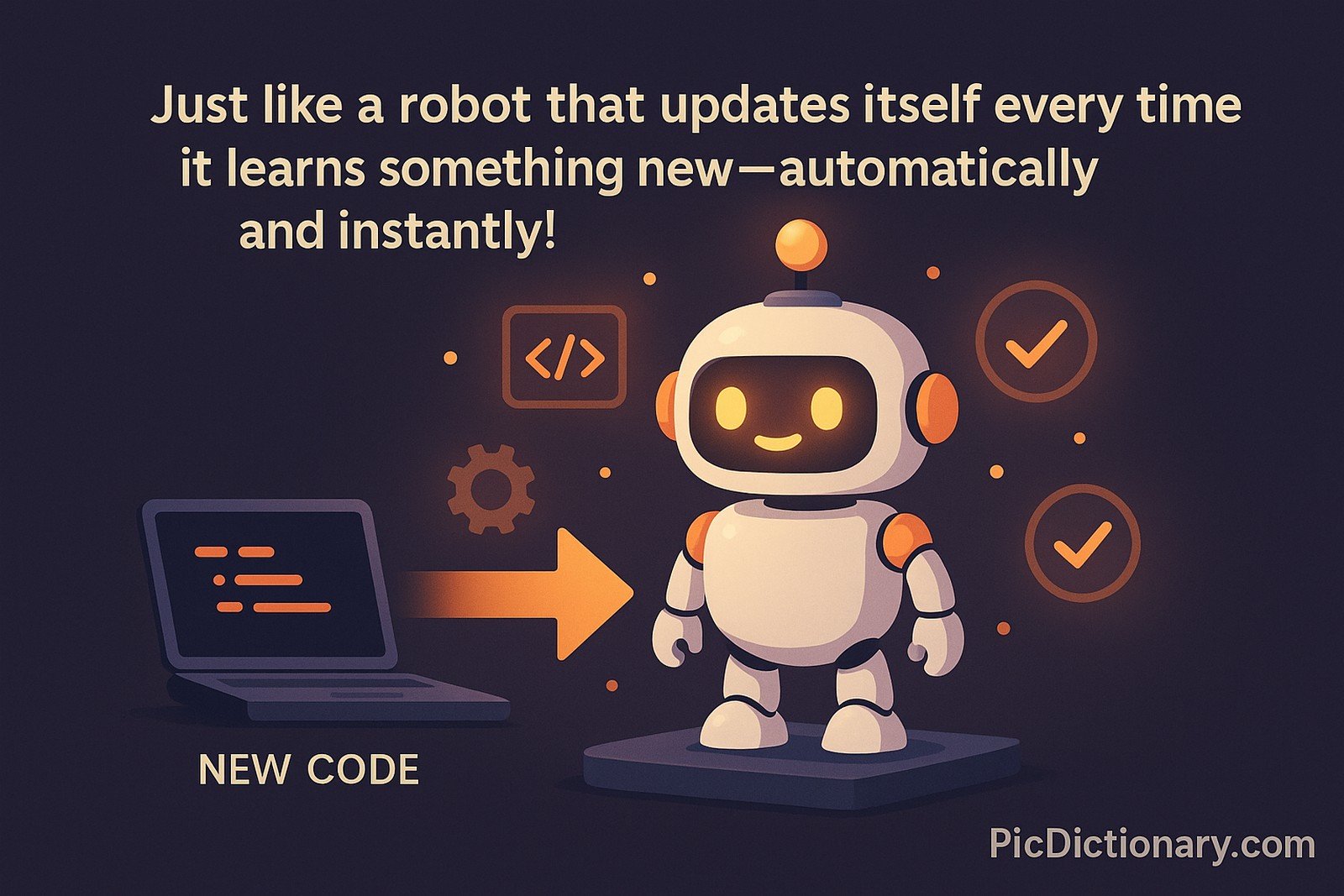
Continuous Deployment Origin
The concept of Continuous Deployment emerged as an evolution of Continuous Integration (CI) and Continuous Delivery (CD). It gained traction in the early 2000s with the rise of Agile methodologies and DevOps culture, aiming to reduce delays between writing code and delivering it to users.
Continuous Deployment Etymology
The term "Continuous Deployment" comes from the idea of "continuous," meaning ongoing without interruption, and "deployment," referring to the act of releasing software into production.
Continuous Deployment Usage Trends
Continuous Deployment has seen rapid adoption in modern software engineering due to the need for speed and automation. Companies like Amazon, Netflix, and Google rely on CD to deliver new features multiple times a day. The trend has grown alongside cloud computing, Kubernetes, and microservices architecture, making it easier for teams to manage seamless deployments.
Continuous Deployment Usage
- Formal/Technical Tagging:
- Software Development
- DevOps
- Automation - Typical Collocations:
- "Continuous Deployment pipeline"
- "automated software deployment"
- "real-time application updates"
- "zero-downtime deployment"
Continuous Deployment Examples in Context
- A web application updates itself multiple times a day without requiring developers to manually release new versions.
- An e-commerce platform continuously deploys bug fixes and security patches without downtime.
- A mobile app automatically rolls out new features to users without waiting for a scheduled release.
Continuous Deployment FAQ
- What is Continuous Deployment?
Continuous Deployment is a process where code changes are automatically deployed to production without manual approval. - How does Continuous Deployment differ from Continuous Delivery?
Continuous Deployment automatically releases updates, while Continuous Delivery requires manual approval before deployment. - What are the benefits of Continuous Deployment?
It enables faster feature releases, reduces deployment risks, and improves developer productivity. - What tools are used in Continuous Deployment?
Common tools include Jenkins, GitHub Actions, GitLab CI/CD, CircleCI, and ArgoCD. - What are the challenges of Continuous Deployment?
Challenges include ensuring robust testing, handling rollbacks, and maintaining system stability. - Can Continuous Deployment be used in regulated industries?
Yes, but it requires strong compliance controls and audit logs to meet regulatory requirements. - How does Continuous Deployment improve user experience?
It ensures that users receive bug fixes and new features quickly without long waiting periods. - What is a rollback in Continuous Deployment?
A rollback is reverting to a previous stable version when a newly deployed update causes issues. - Is Continuous Deployment suitable for all software projects?
Not always; some projects, especially in highly regulated industries, may require manual approval. - How does Continuous Deployment integrate with DevOps?
It is a core DevOps practice, enabling faster development cycles and collaboration between teams.
Continuous Deployment Related Words
- Categories/Topics:
- DevOps
- Software Development Lifecycle
- Agile Methodology
Did you know?
Facebook engineers deploy code to production thousands of times per day using Continuous Deployment practices. This allows them to roll out features progressively, experiment in real-time, and quickly fix any issues that arise.
PicDictionary.com is an online dictionary in pictures. If you have questions or suggestions, please reach out to us on WhatsApp or Twitter.Authors | Arjun Vishnu | @ArjunAndVishnu

I am Vishnu. I like AI, Linux, Single Board Computers, and Cloud Computing. I create the web & video content, and I also write for popular websites.
My younger brother, Arjun handles image & video editing. Together, we run a YouTube Channel that's focused on reviewing gadgets and explaining technology.




Comments powered by CComment