
Register Renaming
Quick Navigation:
- Register Renaming Definition
- Register Renaming Explained Easy
- Register Renaming Origin
- Register Renaming Etymology
- Register Renaming Usage Trends
- Register Renaming Usage
- Register Renaming Examples in Context
- Register Renaming FAQ
- Register Renaming Related Words
Register Renaming Definition
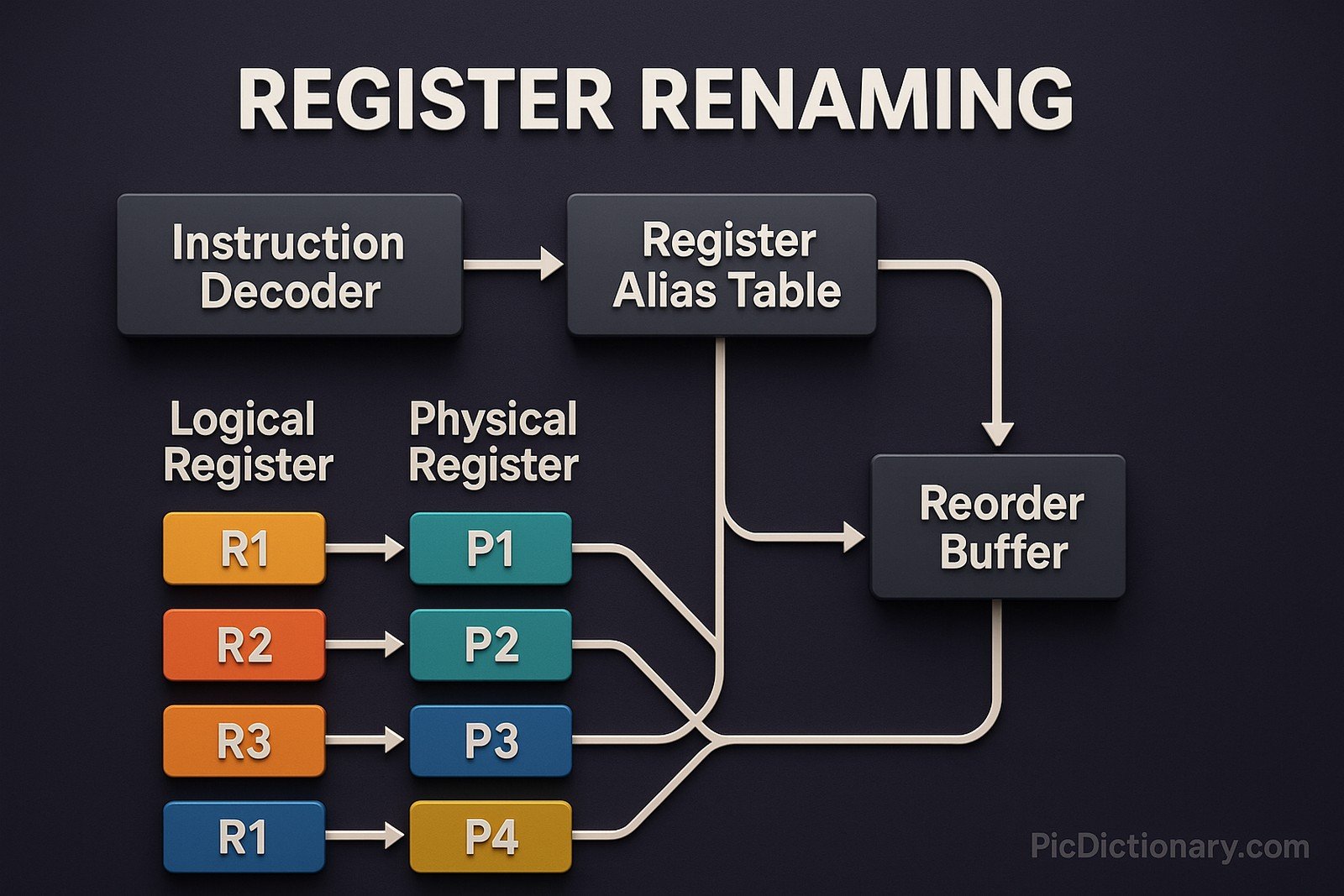
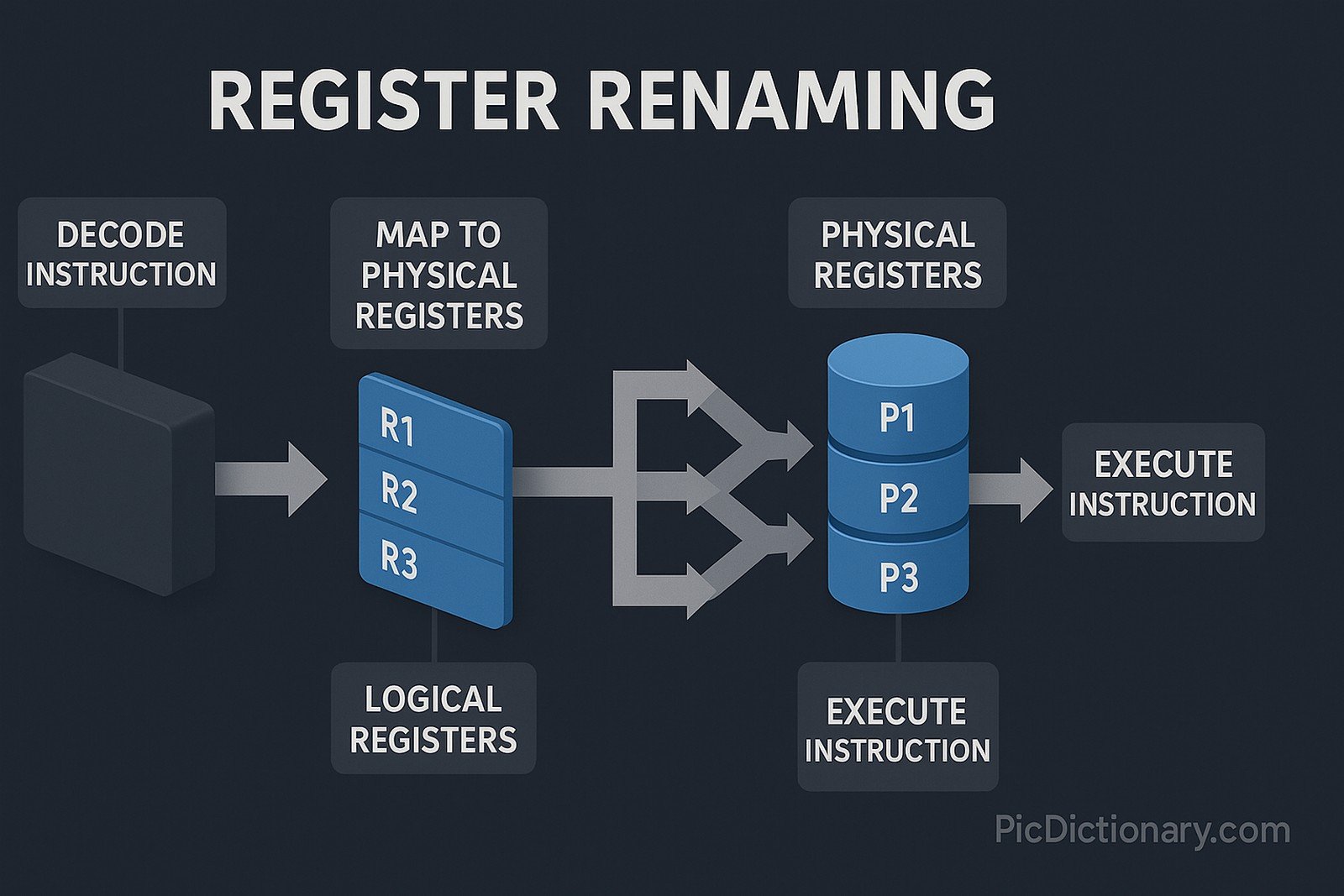
Register renaming is a technique used in computer architecture to eliminate false data dependencies, particularly Write-After-Write (WAW) and Write-After-Read (WAR) hazards. It dynamically assigns physical registers to variables instead of using a fixed logical register set, allowing multiple instructions to execute simultaneously without conflicts. This optimization improves instruction-level parallelism and boosts CPU performance in superscalar processors.
Register Renaming Explained Easy
Imagine you and your friend are working on a school project, and both of you need a single pen to write. If you wait for each other to finish using that one pen, it slows things down. But if you each get your own pen, you can write at the same time without any issues. Register renaming works the same way in a CPU—it makes sure different instructions don’t fight over the same register by giving them unique ones.
Register Renaming Origin
Register renaming emerged as a solution to data hazards in the early days of pipelined computing. The concept gained importance with the rise of superscalar processors in the late 1980s and early 1990s, where multiple instructions needed to execute in parallel without dependency conflicts.
Register Renaming Etymology
The term “register renaming” comes from the practice of dynamically assigning (or renaming) registers to prevent conflicts, ensuring efficient parallel execution of instructions.
Register Renaming Usage Trends
Modern CPUs, including those used in desktops, servers, and mobile devices, implement register renaming to optimize execution pipelines. The technique is vital in out-of-order execution, allowing processors to handle more instructions per clock cycle. Over time, register renaming has evolved with advancements in CPU design, becoming a fundamental part of high-performance computing.
Register Renaming Usage
- Formal/Technical Tagging:
- Computer Architecture
- CPU Optimization
- Instruction-Level Parallelism - Typical Collocations:
- "register renaming mechanism"
- "register renaming in superscalar processors"
- "eliminating data hazards using register renaming"
- "out-of-order execution with register renaming"
Register Renaming Examples in Context
- Modern CPUs use register renaming to allow multiple arithmetic operations to be executed in parallel without interference.
- Out-of-order execution in Intel and AMD processors relies on register renaming to resolve data dependencies dynamically.
- High-performance gaming processors leverage register renaming to optimize real-time processing speeds.
Register Renaming FAQ
- What is register renaming?
Register renaming is a CPU optimization technique that assigns physical registers dynamically to remove data hazards and improve execution efficiency. - Why is register renaming important in modern processors?
It allows CPUs to execute multiple instructions simultaneously without conflicts, boosting overall performance. - How does register renaming eliminate false dependencies?
By mapping logical registers to different physical registers, register renaming prevents Write-After-Write (WAW) and Write-After-Read (WAR) hazards. - Which CPUs use register renaming?
Almost all modern processors, including those from Intel, AMD, and ARM-based designs, incorporate register renaming. - Is register renaming used in GPUs?
While primarily a CPU technique, similar concepts exist in GPUs to optimize parallel computation. - How does register renaming relate to out-of-order execution?
Register renaming enables out-of-order execution by ensuring that instruction dependencies do not stall execution pipelines. - Can software developers directly control register renaming?
No, register renaming is handled at the hardware level by the CPU's instruction scheduler. - What happens if register renaming is not used?
The processor may suffer from execution stalls due to artificial data dependencies, reducing performance. - Does register renaming affect power consumption?
Yes, while it improves performance, it also increases hardware complexity and power usage in modern processors. - Is register renaming necessary in all computing architectures?
It is essential in high-performance CPUs but may not be required in simpler, in-order execution processors.
Register Renaming Related Words
- Categories/Topics:
- Computer Architecture
- CPU Performance Optimization
- Out-of-Order Execution
Did you know?
Register renaming was a game-changing innovation in CPU design. It was first implemented in IBM's early superscalar processors and later became a standard feature in Intel and AMD architectures. Without it, modern CPUs would struggle to achieve the high levels of parallelism required for today’s computing demands.
PicDictionary.com is an online dictionary in pictures. If you have questions or suggestions, please reach out to us on WhatsApp or Twitter.Authors | Arjun Vishnu | @ArjunAndVishnu

I am Vishnu. I like AI, Linux, Single Board Computers, and Cloud Computing. I create the web & video content, and I also write for popular websites.
My younger brother, Arjun handles image & video editing. Together, we run a YouTube Channel that's focused on reviewing gadgets and explaining technology.




Comments powered by CComment